Yiran Long
Approaching Focus Isle at sunset

FocusGaze

01 / 07
Scroll to explore the project

03 · Team project · 2026 · Game design

FocusGaze

MR auxiliary attention training
Living in an immersive training space

FocusGoze targets children with ADHD, blending game-based MR training with eye-tracking interaction to deliver low-threshold, adaptive attention support.

Through the “Focus Isle” concept, the system forms a multi-sensory, engaging experience, building focus through positive feedback and real-life transferable tasks. It serves as both a training tool and a playful intervention ecosystem for children and parents.

FocusGaze original project illustration
Why ADHD children need adaptive, engaging, and family-supported attention training BACKGROUND 8% A D H D Attention-Deficit / Hyperactivity Disorder, is a neurodevelopmental condition involving persistent inattention, hyperactivity and impulsivity. These symptoms can interfere with children’s learning, family routines and social interaction. ADHD, Inhibitory Control Distracting stimuli carinterrupt the intendedaction. Time & Emotion Duration is hard to estimate; frustration rises quickly. Sustained Attention Low-feedback tasks are hard to maintain. Working Memory Rules, sequences and updates are easily lost. My mind drifts involuntarily. I try to focus, yet my attention slips like untamed wind. “ ” AGE 8 · PRIMARY SCHOOL STUDENT Inattention Hyperactivity Impulsivity Training-Relevant Difficulties What is ADHD? Symptoms to Design Opportunity Current Intervention Gap ADHD support often involves behavior therapy,parent training, school support and,whenappropriate, medication. The daily gap issustained practice: parents may lack methodschildren may resist static tasks, and doctorscannot accompany every routine scenario. 8% global teens have ADHD, with inattention, hyperactivity and poor executive function. attention, impulse executive, function SYMPTOMS hard to start, sustain and recover DAILY BARRIERS short, embodied, adaptive feedback MR TRAINING
Theory Support Data Support RESEARCH SKILL COMPETENCE EXECUTIVE FUNCTION MOTIVATION & EMOTION ADAPTATION & MAINTENANCE Parent knows the principle but cannot execute it correctly. The strategy is not delivered at the required moment. Conflict changes the caregiver’s response. Skills learned in treatment are not transferred to new situations. < 50% 40-60% of parents have difficulty fully participating complete prescribed BPT homework assignments 100% ≤ 75% ≤49% IDENTIFIED AS APPROPRIATE Starting reference population ENROL IN BPT COMPLETE TREATMENT At best, after combined attrition At most, after pre-treatment attrition ≥25% DO NOT ENROL Lost before treatment begins +26% DROP OUT AFTER STARTING Additional attrition during treatment Evidence-based Parent Training in Behavior Management Behavioral classroom intervention First-line Methylphenidate may be considered only when behavioral intervention is insufficient and serious impairment persists. Medication condition FDA-approved ADHD medication Parent Training in Behavior Management Behavioral classroom intervention Individualized school support Combined clinical pathway AGE IMPAIRMENT FAMILY CAPACITY TREATMENT RESPONSE COMORBIDITY Medication with adolescent assent Evidence-based behavioral or skills intervention School coordination Monitoring of adherence, adverse effects and emerging comorbidity Treatment pathway Age 4-5 Age 6-10 Age 12-18 40–60% of parents struggle to participate fully, while fewer than 50% complete prescribed BPT homework. Understanding a strategy does not always translate into consistent practice at home. From referral to completion, participation steadily declines: around 75% attend an initial appointment, but fewer than 49% complete treatment. Support is needed both to help families begin and to sustain their engagement over time.
routine & supportaction & dataCLINICANFAMILYGAMECHILD"Do I have to finish everything at once?""Was the session completed, and where did difficulty occur?""How long will this take, and can I stop between tasks?""I need patterns across session: not onlv one score."USER RESEARCH & DESIGN PRINCIPLESTREATMENT ECOLOGY① Task initiation obstacles"I don't know where to begin.""I tend to space out when the teacher assigns a long task."③ Emotional and behavioral characteristics④ Daily adaptation difficultiesI will cry for a long time"I get really angry when I lose.""I don't want to do it anymore after being criticized.""I don't know how long 10 minutes actually is.""Often forget to brush your teeth and wash your face"② Sensory physiological characteristics"The noise in the classroom really bothers me.""They'll only listen if you shake your legs."It's hard to stay still while sitting. Prefrontal lobe development delayDifficulty maintaining attentionWeak impulse inhibitionLack of time perception
ACCEPTABLE SESSION TIMEPRELIMINARY RANGE - NOT AN ATTENTION LIMIT0153045TSTM VRmin10-40 min - mean 21.31EndeavorRx=25 min/dayPlan-It Commander30-45 minVision Pro20-30 min starting session ACCEPTABLE STARTING SESSION RANGEPREFERRED MODULE LENGTH20-25 MIN4-5 MIN
Visible successOverload/ WithdrawalTask variationAchievable challengeShort transitionRepeated failureSudden difficultyUnclear progressRepetitionHighLowCognitive & Emotional LoadSession ProgressEMOTIONAL LOAD DURING TRAINING1/3Avoid Boring Or Difficult Tasks1/2Value Choice And Control7/16Visible Progress Helps Sustain Engagement
Vision Pro Eye-tracking Recognition Spatial ComputingTransform focus training into engaging MR games kids enjoy repeatedly with visible feedback for parents Look at the target Maintain focus Track the path Resist distractions Dynamic Difficulty Adjustment Child Development Feedback Parent Training Report Lower The Barrier To Entry For Users Increase Sustained Engagement Visualize The Training Process3. USER FEEDBACK & MOTIVATIONTSTM VRPLAN-IT COMMANDER86%83%83%75%Liked the experienceWanted to repeatEnjoyed the graphicsEnjoyed sound & music64%44%54%77%Liked the gameMotivated to playWanted to play moreWould recommend83%44%REPEATMOTIVATED
USER JOURNEYMETHODOLOGYTOOLSTAGE 0STAGE 1World & Narrative DesignDESIGN BRIEFThe child acts as a giant helper: notice a request, make a deliberate choice, and see the environment respond.EYE-TRACKING INTERACTION Look to locateInspired by , the project integrates gaze-based targeting with spatial object interaction. Children can naturally locate and focus on objects within the virtual environment using their eyes, then confirm their choices through pinch gestures. This transforms visual attention into meaningful gameplay, reducing reliance on traditional controllers and encouraging active exploration.Apple Vision Pro's eye-tracking technologyLook → Focus → Pinch → Feedback interaction loop Gaze Detection VISIBLE PROGRESSConnect short activities through persistent changes in the island environment.1CLEAR TARGETReduce uncertainty by presenting at a time.one recognizable goalVisual priority2DELIBERATE ACTIONSeparate finding a target from confirming a valid action.3 Inspired by, FocusGaze transforms a child's desk into a magical world. After a dream storm scatters the seeds of the Tree of Life across floating islands, children embark on a journey to collect them and restore their own living terrarium. Every completed challenge brings . miniature tabletop ecosystemsnew life back to the deskFloating Island ExplorationSmall Goals Environmental StorytellingPositive FeedbackPersistent GrowthSpatial GuidanceLong-term ProgressEnvironmental PuzzleGameplay & Visual References01 / Sky: Children of the Light Guide children through using visual landmarks, glowing seeds, and rather than complex navigation interfaces.floating islands environmental cues02|Alba: A Wildlife Adventure Nature-focused exploration and small achievable activities inspire an approachable, .low-pressure experience03|Snufkin: Melody of Moominvalley Translate attention-based actions into , allowing plants, seeds, and island elements to react visibly to player interaction.organic environmental responses
STAGE 2PLAYGROUNDGoalRuleFeedbackProgressCognitive Gameplay DesignINHIBITORY CONTROLGo/No-GoTask SequencingMemory MatchingInhibitory control enables individuals to suppress automatic responses and resist distractions in order to achieve a goal. Participants respond to designated while withholding responses to. Performance is typically assessed through response accuracy, errors, and reaction time.Go stimuli No-Go stimuliGO/NO-GOSELECT FLOWERSWORKING MEMORYPLANNING & TIME MANAGEMENTWorking memory supports the temporary maintenance and manipulation of information needed to complete goal-directed tasks. Participants briefly observe visual information, retain it in memory, and identify after the information is hidden or rearranged.matching itemsMEMORY MATCHINGREMEMBER CUESPlanning and organizational skills help children break down complex goals, organize actions, and complete tasks in a structured sequence.TASK SEQUENCING BUILD SHELTERParticipants organize a series of actions according to task requirements, consider prerequisites, and monitor progress toward a defined goal.Research BasisCognitive GoalInteractionPlayer Action Inspired by the , children practice by while ignoring distractors. They use to locate and to confirm, receiving immediate collection feedback.Go/No-Go principleinhibitory controlselecting target flowersgaze pinch working memoryvisual memory-matchingremember visual cuesmatch pairs of leavesChildren practice through a task. They and , using gaze-based selection and pinch confirmation. Successful matches provide instant feedback and visible progress. Memory Matching task-sequencing principlesplanning and organizationcorrect order. Visual task cues and time indicatorsBased on , children practice by completing construction steps in the guide each action, while persistent progress connects individual tasks to island restoration.Player Journey & FeedbackGAME SYSTEM INTEGRATIONIsland ExplorationTerrarium Growth Three independent cognitive tasksCognitive ChallengesSeed RewardsThree independent cognitive tasks are connected through exploration, rewards, and persistent ecosystem growth, forming a continuous gameplay loop. TASKPLAYER RULEFEEDBACK / BOUNDARY Select flowersCollect the requested colour; ignore distractors.Visible collection; return after distraction.Remember cuesPair matching leaves in the prototype.Spatial n-back is an extended design, not the same rule.Build shelterOrder prerequisites and coordinate helper tasks.Finish within nine time blocks; retry without punishment.

08 · Map / Characters / Assets

Game design · Build a legible world

Concept art · Controlled complexity

Multiple routes, characters, and environmental events are retained during the conceptual phase because the training goal is not to simplify the scene, but to teach children how to identify the current task within a complex environment.

Modular assets · Difficulty control

Terrain, bridges, plants, and props are broken down into modules, allowing future additions of distractions, obstructions, or routes without altering the fundamental rules children have already learned.

Character roles

The yellow character is Mianmian, who is also the initiator of the task: it clearly states the goal before the start of the level and brings the child's attention back to the current step when they get distracted.

The green character is the task partner: it appears near the route or task points and participates in transporting, collecting, and dividing tasks.

The two use different hat styles, hair colors, and clothing colors to enable children to quickly distinguish their identities in a high-information-density scene; subsequent NPCs can follow this character grammar instead of relying solely on changing colors to create new characters.

Model & texture design

When modeling in Blender, at first I attempted to use the shaders created in Unity. However, due to the incompatibility between the shaders and VVisionPro, as well as the model's lagging performance, I replaced all the materials with textures.

Unity · Build the playable rule

After importing the island and the mission object into Unity, I first checked if the child could see the landmarks from different angles, and then added the programs and gameplay involving gaze, merging and collision.

09 · Three cognitive tasks

Game design · Actions, rules & feedback

Level 1

Suppression & control

Learn to find the target, resist interruption and return after distraction.

In a low-density scene, the child finds the requested flower, holds a stable gaze to open the route, and pinches to collect it. Wrong colours, passing characters and brief sounds are added gradually. Looking away pauses progress instead of failing the level, making attention recovery visible and repeatable.

TRAINING LOOP Locate → hold gaze → ignore distractor → pinch
DIFFICULTY 1 target → colour distractors → moving cues → shorter window

Eyes gaze at the flowersFlowers appear in different colorsCollect flowers of the correct color (blue).

Level 2 · Extended design

Working memory

Spatial n-back / Continuous update

I embedded the n-back rule in spatial leaf searching. Each leaf reveals a cue briefly, then closes. The child retains recent cues, updates the sequence and checks whether the new pattern matches the one shown n steps earlier.

Each reveal follows the same loop: MAINTAIN the recent cues → UPDATE with the new cue → COMPARE with n steps back → DECIDE whether to pinch or ignore.

1-BACK Compare with the previous cue
2-BACK Compare with the cue two positions earlier
MATCH Pinch to confirm · NO MATCH Ignore and continue

The recorded prototype below uses pair matching. Spatial n-back is the extended design.

Shrub: Similar leaves increase spatial occlusion
Tree: Viewpoint shifts add height, depth and location memory

Board → Shrub → Tree · span · candidates · reveal time · interval · similarity · occlusion

Level 3

Time allocation before the rainstorm

A torrential rain is approaching, and the player, as a "giant," needs to cooperate with two little elves to build a rain shelter within 9 time blocks.

Players manage personal, assistant tasks and priorities under time limits to boost planning, timing, task-switching and anti-distraction skills.

Start first, then adjust

Children facing multitasks skip perfect planning, take actionable steps first, and adjust gradually through practice.

Safe trial-and-error

No penalty for failure. Players reset freely with in-game encouragement to explore safely amid mistakes.

There are currently no idle characters available for work.The time for advancing one grid by pinching

Helper tasks

  1. Find the main beam branches
  2. Look for large leaves
  3. Collect sturdy vines

Player actions

  1. Flatten the sand foundation
  2. Erect the main beams
  3. Cover the leaf roof
  1. Assign tasks
  2. Player actions
  3. Time synchronization
  4. Complete the shelter

Recorded MR prototype

From a shared island to a focused task

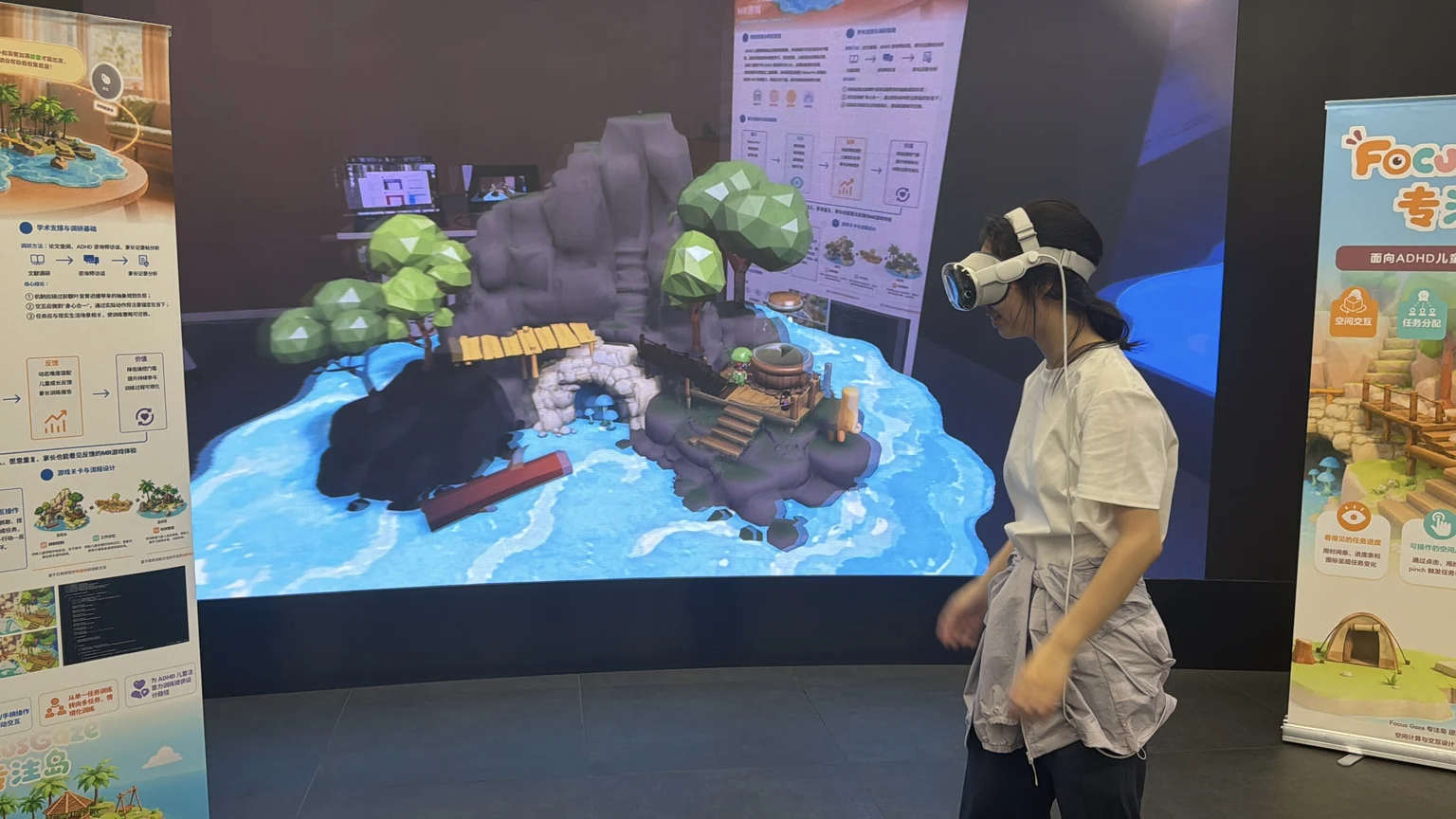
Watch the experience in a real room: explore the island, remember matching leaves, then pick flowers and place them in the basket. Visible counters show progress through each activity.

Full prototype recording · 3 min 07 sec

Technology & demonstration

PROGRAMMING & DEVICE TESTINGUNITY / SCRIPT SETUP01 Confirm a waypoint02 Move, then activateConfirm my waypoint first. I'll move there, then start the task.01 / Spatial input & navigationLook to locate a candidate. Pinch to commit the action.SPATIAL POINTER / CONFIRMATIONstate = GetPointerState(touch); if (Began && IndirectPinch) { target = state.targetObject; Confirm(target); }WAYPOINT / COMMIT → ARRIVEOnConfirmed(point) { if (!CanAct(point)) return; navigator.MoveTo(point); } OnArrived(point) { point.TryActivateTask(); }LOOK → PINCH → MOVE → ARRIVE → TASK Update the bridge, weather and progress. Keep each result in the session.04 / Scene feedbacksession.Record(result); bridge.Apply(phase); weather.Apply(phase); progress.Update();PHASE RESULT / WORLD + SESSION Pink flowers only! Others add an error.02 / Flower selectionOnPinched() { if (flowerType == Pink) Collect(); else errors++; } Matched pairs stay. Find them all to move on.03 / Pair matchingif (IsFlipped || IsMatched) return; Flip(); a.PairId == b.PairId ? SetMatched() : FlipBack(); Finish prerequisites first.05 / Task dependenciesIsUnlocked => !IsCompleted && dependencies.All( d => d.IsCompleted);06 / Work durationwhile (progress < 1f) { progress += deltaTime / duration; UpdateBar(); }07 / Time allocationtimeRemaining -= deltaTime; if (timeRemaining <= 0) Restart(); AdvanceSlot(current + 1);Work time fills the progress bar.Each action uses a time slot.
TERRAIN / TRAVERSAL STUDY
FocusGaze tested with the headset in the original room
Headset demonstration

Interface design · Parent companion

9:41TodayProgressLiveChildNext practiceSuggested for YellowEXAMPLE PLAN15 minutes together0–6 minCollect flowers6–8 minTake a break8–15 minMatch leavesPARENT CUEOne cue, then a little time.From 4 flower visits and your Oct 18 note.Why this plan? ↗Confirm this planReview tasks & timing ›Today’s practice6 min2 min7 minWeekly overview9:41TodayProgressLiveChildOCTOBER 12–18Your practice weekPRACTICE DAYS4days together3 last weekM12T13W14T15F16S17S1861 mintogether9 / 12tasks finishedAFTER A FLOWER CUE12s → 6sTime to the next flower action, from the first visit to the latest.Explore this patternOpen training calendar ›Example dataPractice pattern 9:41TodayProgressLiveChildPractice patternsReturning after a cueFlower task · Same difficultyEXAMPLE DATA12 → 6seconds4 comparable visits0s6s12s12Oct 1210Oct 147Oct 166Oct 18Oct 18 · Flowers05:14 Cue05:20 Next action6 secParent note ›View planVisit historyVisit detailsVISITS PER WEEKFour-week view2Sep 213Sep 283Oct 54Oct 12Watch in full screenTake a breakContinue2 minFocus IsleStartMatch the leaves2 / 2Pinch the matching color1 / 2Look at the flowersReady · not sentSendAll done, Yellow!2 / 2 tasksDonePARENT COMPANIONA parent companion designed around four steps: prepare, support, review and plan. Familiar characters and game imagery connect the mobile interface with the child’s MR experience.01 / PREPARATIONCheck headset connection and battery status, then follow simple guidance for play space, headset fit and pinch interaction before starting.02 / NEXT PRACTICEPreview task order, duration and breaks. Familiar game imagery makes each next step clear.03 / LIVE COMPANIONView gameplay full screen. Hold to Talk, Show Target and Pause keep support close.04/ IN-GAME GUIDANCEStart, break and completion panels mark each stage of the session. NPC prompts, visible progress and immediate feedback help children understand what to do and what happens next.